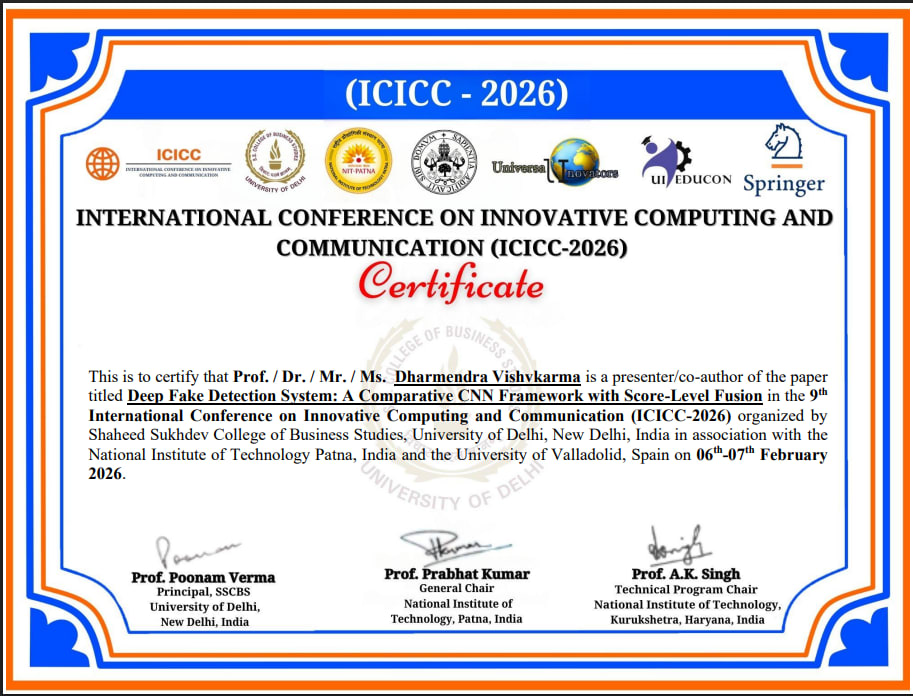
From Research to Real Impact: Presenting My Deep Fake Detection System at ICICC-2026
In February 2026, I had the opportunity to present my research paper titled "Deep Fake Detection System: A Comparative CNN Framework with Score-Level Fusion" at the International Conference on Innovative Computing and Communication (ICICC-2026).
Why Deep Fake Detection?
Deep fake technology is growing rapidly and poses serious risks in misinformation, identity theft, and digital fraud. The objective of our research was to design a system capable of detecting manipulated media using deep learning techniques.
Problem Statement
Most deep fake detection models rely on a single CNN architecture. However, individual models often fail to generalize across different datasets and manipulation techniques. Our goal was to improve detection accuracy by combining multiple CNN models using score-level fusion.
Technical Approach
- Used multiple Convolutional Neural Network (CNN) architectures
- Extracted spatial features from manipulated and original images
- Applied score-level fusion to combine predictions from different models
- Compared performance metrics such as accuracy, precision, recall, and F1-score
Key Contribution
Instead of relying on a single deep learning model, we implemented a comparative framework and fused model outputs to improve robustness and reliability. The fused model achieved better consistency across validation datasets.
Challenges Faced
- Handling overfitting due to limited dataset diversity
- Model training optimization and hyperparameter tuning
- Balancing computational cost with accuracy
Conference Experience
Presenting at ICICC-2026 exposed me to researchers, academicians, and industry professionals. I received valuable feedback on model scalability and real-world deployment challenges. The discussion helped me understand the gap between research prototypes and production-ready AI systems.
What I Learned
- Research requires structured experimentation and documentation
- Model comparison is more important than blindly improving accuracy
- Real-world AI systems must consider scalability and efficiency
- Presenting research builds confidence and clarity of thought
Moving Forward
This research experience strengthened my foundation in deep learning and practical AI system design. It also reinforced the importance of combining academic research with real-world software engineering practices.
I aim to further explore AI model optimization and deployment strategies in future projects.